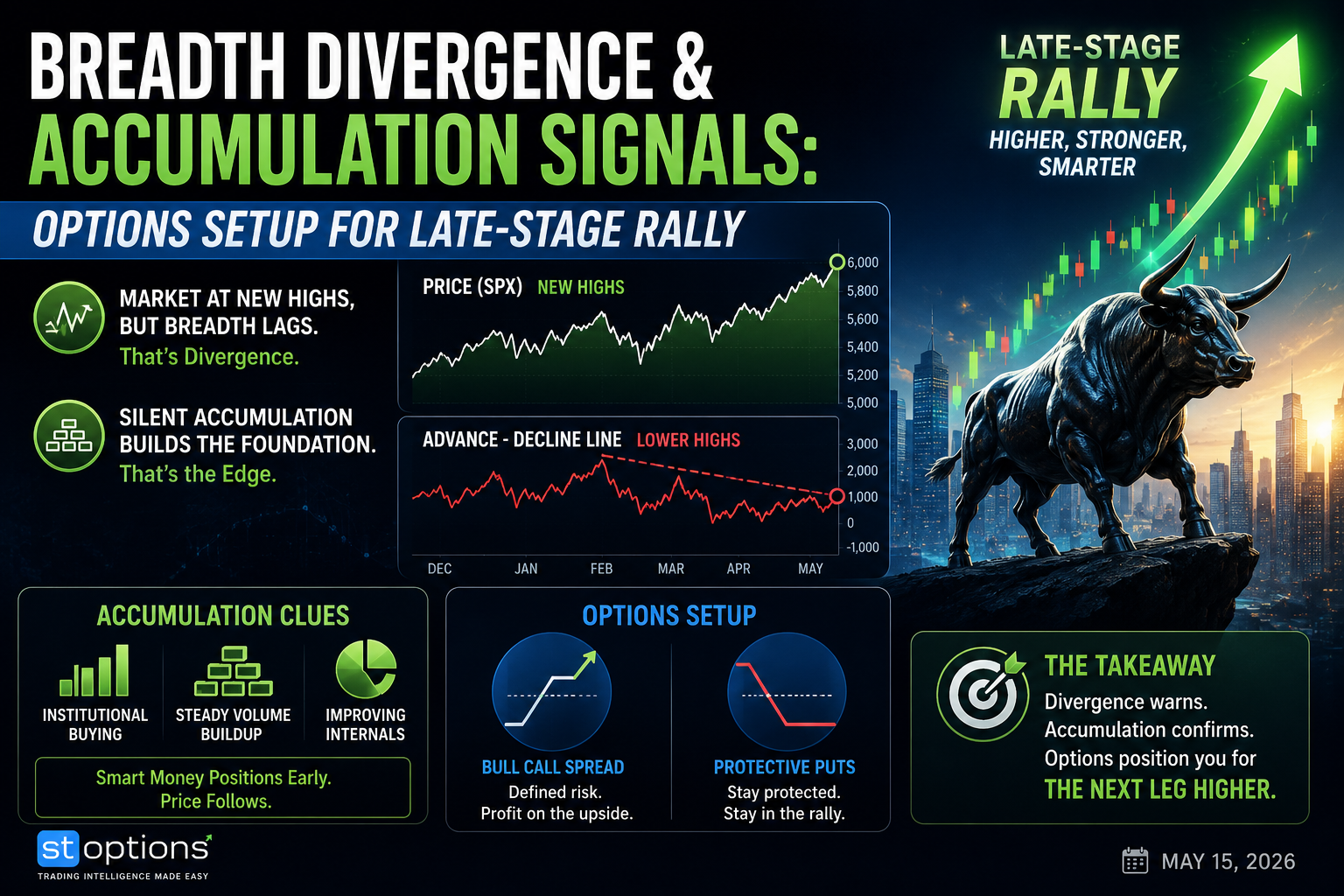
The Breadth Puzzle: Why Equal-Weighted Indices Matter More Than You Think
When broad-market indices like RSP (the equal-weighted S&P 500) diverge from cap-weighted benchmarks, it signals a shift in market structure that options traders cannot ignore. Equal-weighted indices reflect participation across all constituents equally, whereas cap-weighted indices are dominated by mega-cap names. The current setup—where RSP is displaying a bull flag pattern approaching resistance near 8,300—suggests that accumulation is occurring across smaller constituents within the index, not just concentrated in a handful of mega-cap names.
This breadth expansion is critical for options traders because it affects volatility distribution and tail risk. When accumulation occurs across a broad base, implied volatility tends to compress more evenly across strike prices, creating cleaner risk/reward profiles for directional spreads. Conversely, when breadth deteriorates while the cap-weighted index rallies, volatility skew widens—a warning sign that the rally may lack conviction.
The Nasdaq 100 breadth metrics showing potential topping signals alongside accumulation volume creates a classic late-stage rally environment. This is precisely where understanding market regime states becomes essential for position sizing and strike selection. A trader holding bullish positions in this regime must tighten stops and reduce position size relative to account risk.
Volume Accumulation vs. Distribution: Reading the Tape for Options Entry Signals
The distinction between accumulation and distribution volume is foundational to options trading, yet many traders conflate rising prices with bullish volume structure. In this market setup, trading volume is confirming accumulation—meaning buyers are stepping in on dips and holding positions through resistance tests. This is bullish, but with a critical caveat: it's occurring in a late-stage rally environment where the risk of reversal has increased.
For options traders, accumulation volume translates to lower probability of sharp reversals in the near term, which affects both call and put pricing. When accumulation is confirmed by on-balance-volume momentum (as seen in the Dow Industrial Average), call spreads become more attractive than naked long calls, because the probability of a sustained move higher is moderate rather than extreme. Conversely, put spreads and ratio spreads become riskier.
The key is to use momentum scanning across S&P 500 and Nasdaq 100 to identify which specific tickers within these indices are showing the strongest accumulation signals. Not all constituents are equal; some may be distributing while the index accumulates. This granular view allows you to construct directional spreads that target the strongest accumulation zones rather than betting on the entire index.
Bull Flags and Resistance Tests: Implied Volatility Rank as a Position Sizing Tool
A bull flag pattern—characterized by a sharp move followed by a consolidation period—is one of the most reliable continuation patterns in technical analysis. RSP's bull flag approaching breakout at 8,300 fits this template. However, the options trader's edge lies not in recognizing the pattern, but in understanding how implied volatility rank (IVR) changes as the pattern matures.
Typically, IVR compresses during consolidation phases because the market is uncertain about direction. As the flag approaches breakout, IVR often remains suppressed until the breakout is confirmed. This creates a timing mismatch: the technical setup is most bullish precisely when options premiums are cheapest. Conversely, once the breakout occurs, IVR often spikes, making long calls expensive and short puts risky.
The strategic implication is to establish bullish positions before the breakout, when IVR is low, rather than chasing after the move. This requires discipline and forward-looking analysis. Use position sizing tiers aligned with the 2% risk rule to ensure that even if the breakout fails, your account can absorb the loss. Mixed technicals on the Dow suggest that not all indices will break out simultaneously, so diversify your directional bets across RSP and other equal-weighted proxies rather than concentrating risk in a single ticker.
Late-Stage Rally Conditions: Why Defensive Positioning Matters Now
The headline explicitly notes "late-stage rally conditions," which is a regime descriptor that should fundamentally alter your position construction. Late-stage rallies are characterized by strong momentum but deteriorating breadth, elevated valuations, and increasing vulnerability to profit-taking. Bitcoin testing its 200-day moving average is a classic late-stage signal—it suggests that even risk-on assets are consolidating rather than accelerating higher.
In this regime, the optimal options strategy shifts from aggressive directional plays to defined-risk structures with favorable risk/reward ratios. Call spreads outperform naked long calls because they cap your loss while still capturing upside. Iron condors and ratio spreads become attractive if you believe the index will consolidate rather than break out decisively. The Nasdaq breadth warning is particularly important: it suggests that while the index may continue higher, the number of advancing stocks may not, creating a divergence that often precedes reversals.
Use the Morning Brief to track breadth metrics and IVR across your watchlist daily. This discipline ensures you're not caught off-guard by a regime shift. When breadth deteriorates sharply while price holds, it's often a signal to reduce long gamma exposure and increase short gamma positions. The 2% risk rule becomes even more critical in late-stage environments because the margin for error shrinks as volatility can spike unexpectedly on distribution days.
Actionable Framework: Constructing Spreads in a Divergent Breadth Environment
Given the current setup—bullish accumulation, bull flags, but breadth divergence and late-stage conditions—here's a practical framework for options traders:
For bullish conviction: Use call spreads (buy ATM call, sell OTM call) on RSP or other equal-weighted proxies. This caps your loss to the spread width while maintaining defined risk. Size positions so that the maximum loss equals 2% of your account.
For neutral-to-cautious outlook: Construct iron condors or short strangles on indices showing mixed technicals (like the Dow). Sell premium at resistance and support levels identified by the bull flag pattern. Collect theta decay while the index consolidates.
For hedging: If you're long equities, consider buying put spreads (buy OTM put, sell further OTM put) on the Nasdaq 100 to protect against the breadth warning. The cost is lower than naked puts, and the defined risk aligns with late-stage rally vulnerability.
Always cross-reference your setup with composite scoring and position sizing tiers to ensure your conviction level matches your capital allocation. A bull flag with accumulation might score 7/10 on momentum, which should translate to a medium position size, not a maximum bet. This discipline separates profitable traders from those who get caught in reversals.
Frequently Asked Questions
What does it mean when equal-weighted indices show a bull flag while cap-weighted indices show mixed technicals?
It indicates that smaller constituents are accumulating while mega-cap names are consolidating or distributing. This breadth divergence suggests the rally is broadening but losing conviction at the top. For options traders, this means directional bets on equal-weighted proxies like RSP are more reliable than bets on cap-weighted indices. However, the divergence also warns that the rally may be nearing exhaustion, so position sizing should reflect this late-stage risk.
Why is accumulation volume bullish for call spreads but bearish for naked long calls?
Accumulation volume suggests moderate upside probability—enough to sustain the move, but not enough for explosive gains. Call spreads profit from moderate moves and decay theta, making them ideal for accumulation environments. Naked long calls require larger moves to be profitable and suffer from theta decay, making them less suitable when the market is consolidating despite bullish volume. In late-stage rallies, defined-risk spreads outperform unlimited-risk positions.
How should I adjust position sizing when breadth metrics diverge from price action?
Reduce position size by 25-50% relative to your normal allocation. Breadth divergence signals regime uncertainty, which increases the probability of sharp reversals. Use the 2% risk rule strictly: if a position's maximum loss would exceed 2% of your account, reduce the size. This discipline protects your capital during regime transitions and allows you to re-enter with conviction once breadth confirms price action.
What is the relationship between bull flags and implied volatility rank?
Bull flags typically form during periods of IVR compression as the market consolidates. IVR often remains low until the breakout is confirmed, then spikes as traders react to the move. The strategic edge is to establish bullish positions before the breakout when premiums are cheap, then reduce or exit as IVR rises post-breakout. This timing advantage is critical in late-stage rallies where reversals can occur quickly.
Should I be more defensive in late-stage rally conditions?
Yes. Late-stage rallies are characterized by strong momentum but deteriorating breadth and elevated vulnerability to reversals. Shift from aggressive directional plays (naked long calls) to defined-risk structures (call spreads, iron condors). Increase hedging activity and reduce position size. The goal is to capture remaining upside while protecting against the increased probability of a sharp pullback. Breadth warnings like those in the Nasdaq 100 make defensive positioning essential.